Tuesday, 7 October 2008

Fighting the light II

Man waiting at the bar of a West End pub

Here's another image taken during the London weekend trip. Sometimes images happen because of an event or circumstance. In this case, it was Sophie answering her mobile phone that gave me the opportunity to take a couple of images, while i waited for her return.

This was another of those images taken quickly in less than perfect lighting conditions. Like the underground image posted previously, the light in this image comes from the bright lights above the bar. Some natural light is present but it was nearly dusk outside so the window light was subdued. The light was harsh and typical of most bar and pub environments.

I took two images. This one caught to mood of the pub. The shutter speed was slow, around 1/8th sec, so i rested the camera on the table to keep it steady. The viewfinder prism of the Nikon F3 was removed so i could use it like a waist level viewfinder. Any quick movement by the man would have ruined the shot. Fortunately he didn't move from that stance for a couple of seconds.

Monday, 6 October 2008

Fighting the light

Fighting the light - London Underground escalators

My decision to take the Nikon F3 was a good one. It worked out really well and the fast Nikkor 35mm lens was very useful indeed. The extra few f-stops of speed that the lens possessed made it slightly easier to shoot in the low light of the London underground.

Human eyes have a great ability to even out light emissions. Cameras sadly don't and this makes the harsh lighting from the flourescent strips, located throughout areas of the tube, a challenge when it comes to getting photographs.

The image above was taken at 60th/sec, F2.0 on Ilford FP4. 125 ISO film isn't the best choice for that type of environment but i managed to get away with it. It was just the film in the camera at that time. Thank goodness for fast lenses!

Sunday, 5 October 2008

Weekend away

Shoppers at Norwich Market - June 2008

By the time that you have read this post i should be back from a weekend in London. At the time of writing I'm finishing the final stages of packing an overnight bag and have come (finally!!) to a decision not to take the digital SLR camera with me.

I'm taking a Nikon F3, a Nikkor 35mm lens and a few rolls of film. I don't know if I'll regret taking just a film camera with me but after a bit of thought it seems to make more sense. The F3 is light, compact and easy to carry. Digital does have the big bonus of not having to carry film; get a large capacity memory card and you can snap away till the cows come home. However, the problem with my digital camera is its big, heavy and attracts attention. So it's staying at home.

The forecasted weather has played a part in the decision too. The weekend looks overcast and wet, so the image taking possibilities may be limited. That said, it will be interesting to see 'what i can see' even with the rain. Stay tuned for some London images this week.

Tuesday, 30 September 2008

Profile: Steve McCurry

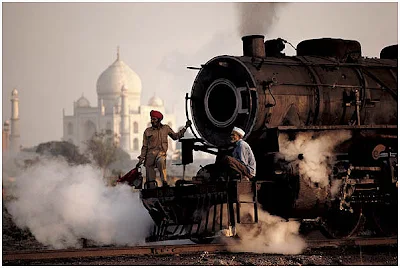
Steam train passing the Taj Mahal, India, 1983 - Image by Steve McCurry

If you are an avid reader of National Geographic magazine then you may be already familiar with the work of Steve McCurry. His evocative portraiture style and distinctive use of colour have guaranteed his place as one of the world's best photographers.

Steve McCurry was born in Philadelphia, USA in 1950. He went onto study History and Cinematography in 1971 which led to a exhibition of images as part of a group show called Envisions at the university's Zoller gallery. After graduating, McCurry worked as a photographer for a local paper until in 1978 he left to become a freelance photographer, departing for India that same year. It was around this time that McCurry first started to use colour film. In May 1979, Steve McCurry entered into a rebel controlled area of Afghanistan, just before the Soviet invasion of the country. The images he would take of there would among the first to cover the remote conflict. A year later he would cover the war for TIME magazine for which he was awarded the Robert Capa gold medal. That same year McCurry was offered an assignment position with National Geographic magazine. For the next few years, Steve McCurry worked extensively in various countries around the world but it would be on the Pakistani border with Afghanistan that he would take one of his most iconic images.

While on assignment for National Geographic in 1984, McCurry entered a girls school set up in an Afghan refugee camp established in Peshawar, Pakistan. He asked if he could photograph some of the pupils. One of them was Sharbat Gula whose portrait has become one of McCurry's most recognised images. The image has all the hallmarks of a typical Steve McCurry's image. The powerful use of colour is just one distinctive element to a image. The green eyes of Sharbat seem to pierce into you as you look at the photograph. They make a deep connection to the viewer. It's not surprising to find out that Sharbat's mother and father had been killed in a bombing raid on their village. Some seventeen years later, McCurry managed to track her down and was pleased to find out that she had a family of her own. ' Her skin is weathered; there are wrinkles now, but she is as striking as she was 17 years ago' comments McCurry on his website.

Throughout the 1980's McCurry worked on various assignments including coverage of the war in the Lebanon. By 1986 he was a contract photographer for national Geographic and was winning awards for his work in the Philippines. Other assignments saw him work in Cambodia but it was in the disintegrating Yugoslavia of 1989 that he was nearly killed. The light aircraft he was traveling in came down in a lake after the pilot was blinded by the light reflecting off the water. Fortunately Steve McCurry and the pilot managed to get free of the sinking plane and were picked up by fisherman but his photographic equipment stills resides on the bottom -60 feet underwater. The early 1990's saw Steve McCurry cover the war in the gulf where an image of a burnt body near to a knocked out tank reflected the true nature of modern warfare. The eerie orange glow from the burning oil wells adds an extra apocalyptic edge to the photograph's poignant message.

In 1992 Steve McCurry joined Magnum as a full member after six years of nominee status. He also returned to Afghanistan to document the rebuilding of the country after the war ended.
McCurry has continued to cover the Afghan people ranging from the children to the workers of the country. The trust and respect comes across in the images. McCurry is trying to understand the person and capture the experiences of the soul. It is like the entire life is reflected in the face of the subject. Many of the images show the ravaged landscape of war, seen through the eyes of the people who live there. On September 11 2001, McCurry was in New York having just returned from working in China. His images of the events that day were exhibited at the New York historical society. It is another image of McCurry's, taken at a high mountain lake at Band-i-Amir in Afghanistan in 2002, that have a strange haunting presence. Two towering pieces of rock can be seen, looking not unlike the World Trade center twin towers, as a wild horse runs of to the right of the photograph. A magical image with haunting tones of the turbulent past. Just another wonderful image taken by one of the world's greatest photojournalists.

All Images are copyright of Steve McCurry
  • Top left - Steve McCurry
  • Middle right - Afghan girl (Sharbat Gula) near Peshawar, Pakistan, 1984
  • Middle left - Painted boy, India, 1996
  • Bottom right - Landscape with horse, Band-i-amir, Afghanistan, 2002

Weblinks

Books

Saturday, 27 September 2008

Rain drops..


This turned out just how i wanted it. A mass of rain drops had run all the way down the window and formed large droplets at the bottom of the window i was near. I sat and watched them form up and drop for ten minutes or so before i decided to photograph them.

Capturing that decisive moment as the droplet made its final plummet to earth was what i was after. It pretty much sums up visually, the dismal rain drenched weather experienced in Britain over the late summer months of this year. Weather for ducks indeed.

Thursday, 25 September 2008

Wet, wet, soaked!

Walking towards Wells next to the sea, Norfolk, UK

You could see it coming. Clinging to the coastline, rolling along and cutting the visibility in half along the coast. A massive black cloud made its way towards me as i walked back to the car park. 'If i move quick' i thought 'I'll make it back dry' but the rain obviously had other ideas and started to come down HARD halfway along this walk.

About five minutes after this photograph was taken, the skies darkened further and the rain lashed down. It was wet, wet, wet. Norfolk is often like this in June and July. Dry, sunny and bright one minute but then dark and stormy the next. For photography i think its the perfect type of weather. You get a nice bit of sun combined with a texture filled sky. For cloudscapes and detailed atmospheric stormy skies, i can't think of anywhere better in the UK.

I was during this walk along the harbour that i came across an old lady totally absorbed in her photography. She had a 35mm disposable camera which she used, quite skillfully, to photograph the bright wild flowers that lined the banks. The look of concentration and the smile on her face as she took her images said it all - she was having a wonderful time.

Friday, 19 September 2008

Question of ethics

Crossing over the Millenium bridge, Gateshead, UK

Jill Greenberg's 'portraits' of presidential candidate John McCain have created quite a storm on the photography blogs. Some commentators write about the freedom to express yourself as an artist but for the most part many think it's just incredibly unprofessional. So do I.

Jill Greenberg's
attitude seems to attack the bond of trust placed in photographers. It is a trust thing. A photographer is hired to do a job, and therefore physically represents the company or person they are working for. If you are working for someone and you behave badly, it reflects on them as much as you. In Greenberg's case, she represented Atlantic magazine who had commissioned her to shoot a cover image for the magazine. She did get that cover image shot but obviously had a completely separate agenda of her own. A strange attitude considering the number of magazine cover assignments she has shot - you'd think she'd know better!

I was once asked whether I'd work on a commission where i didn't like the person or subject. I replied that in business you have to make a choice but that financial implications usually have the final say. You have to be mercenary in your approach and, yes, maybe some of your own ideals have to be re-examined or put to one side. I'm no fan of politicians but if i was offered a commission to photograph one of the main political parties.... I'd do it probably.

Whenever someone asks me about starting in professional photography, i always tell them to imagine what their ideal customer would be like. Maybe a second question should be asked too - what client WOULDN'T you accept a commission from on the grounds of ethics, dislike, etc? An oil company maybe? A weapons manufacturer? A political party?